

 The practice of Hadi Zambarakji

News & Thoughts
Thoughts from RetinaCare
Retinacare’s quarterly newsletter keeps you up-to-date with the latest in retinal care developments. The most recent issue is below, you can browse the archive by clicking the links to the right or subscribe by emailing info@retinacare.org.uk.
Newsletter November 2025
Issue 8.2Sing IMT (implantable miniature telescope) – preliminary work
(Samsara singimt.com)
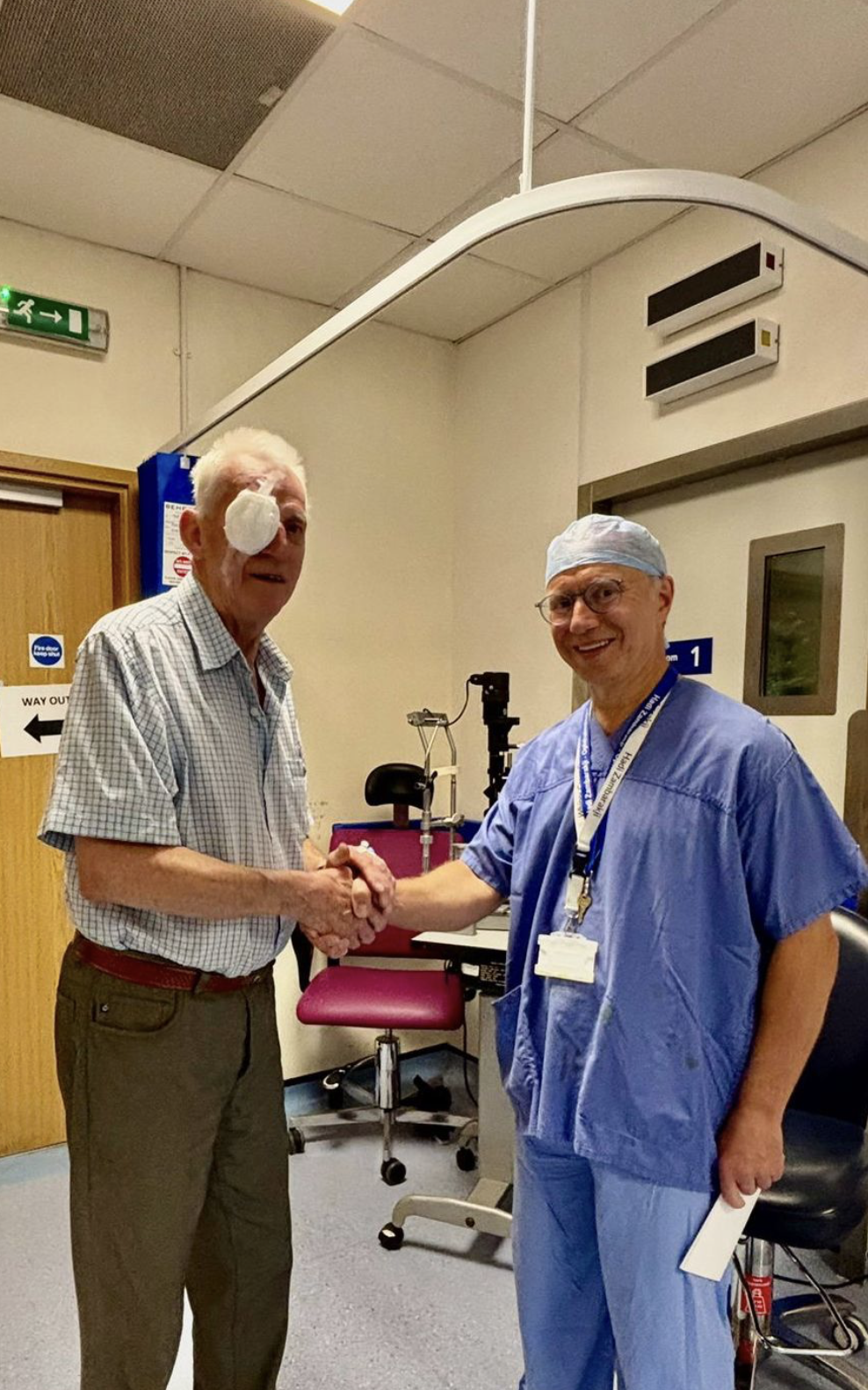
I am happy to share that we have recently done our first phaco cataract surgery procedure with insertion of a miniature telescope implant at Whipps Cross Hospital in London. This is the second generation intraocular telescope (Sing IMT) developed by Samsara, significantly smaller than the first generation device. The precedure is performed in patients with advanced macular degeneration where other treatment options are not of any value because of macular degeneration. One week after surgery, our patient reports doing cross words and seeing text on his TV … absolutely over the moon!
We are very lucky to have a dedicated team involved with this program, including Kate Kotschy our eye clinic liaison officer (ECLO) and low vision support person, Kamalika Disanayake (Gaya) and Meryl James our low vision specialist Optometrists and of course our dedicated team of Ophthalmic nurses.
The patient enrolment is quite strict as the patient needs to be keen to go ahead with the procedure and understand the potential risks of the surgery. The corneal endothelial cell count is assessed preoperatively (requirement > 1,600 cells/mm2) and the anterior chamber depth needs to be a minimum of 2.5 mm. The patient should be phakic in both eyes and intact zonules are essential as the telescope implant is heavier than a normal acrylic IOL. The telescope is inserted in the better eye, so the telescope eye will have improved central vision, whilst a normal phaco and monofocal IOL are done in the fellow eye to give the fellow eye good peripheral vision. The low vision aid (LVA) Specialist Optometrists perform a detailed pre-operative assessment, including a simulator assessment so the patient can have an idea of the magnification prior to surgery. The ECLO also spends much time preoperatively with the patient to ensure that the patient is truly determined to go ahead with the procedure and to discuss any concerns as well as expectations. Post-operatively, more time is spent with the ECLO as well as the LVA team as more training is needed post-operatively, as it is quite important that the patient uses the telescope eye because it would be too easy to ignore the telescope eye if this proves too much hard work!
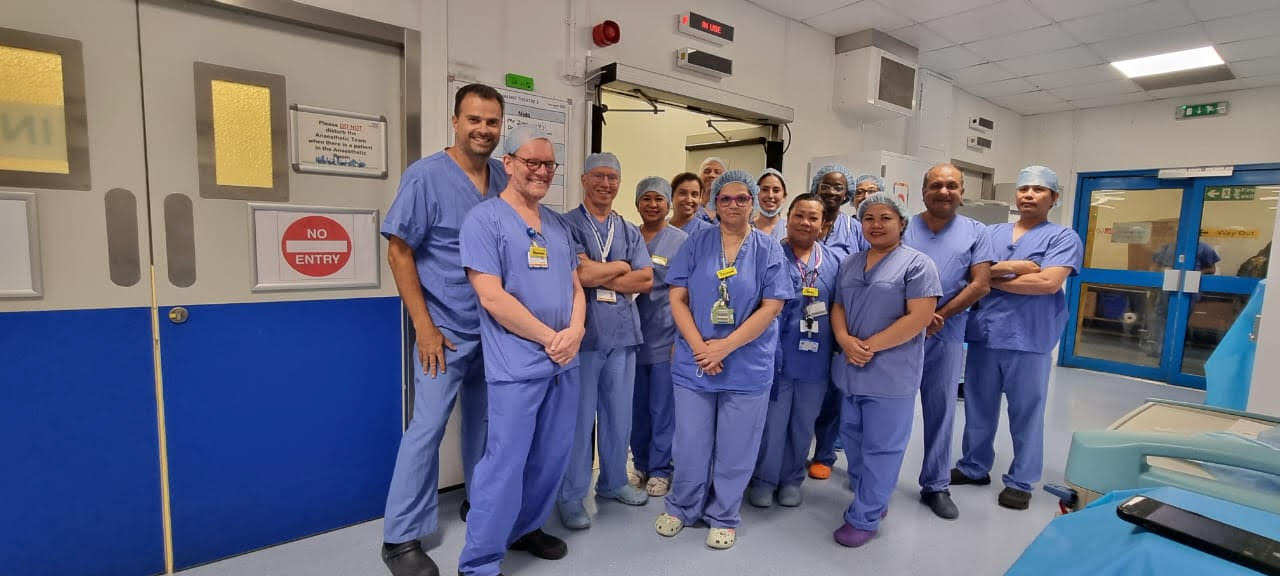
We are all very excited about this work and hope to see referrals from local colleagues to our service for this work.
Please do not hesitate to be in touch should you like to refer a patient.
No comments yet
Leave a comment
Search the RetinaCare website
Register as Sight Impared
Fill out the form here.
Newsletter Archive
 Retinacare Newsletter Issue 8.2 (November 2025)
Retinacare Newsletter Issue 8.1 (January 2025)
Retinacare Newsletter Issue 7.1 (January 2021)
Retinacare Newsletter Issue 6.2 (December 2018)
Retinacare Newsletter Issue 6.1 (November 2018)
Retinacare Newsletter Issue 5.1 (Spring 2016)
Retinacare Newsletter Issue 4.1 (Spring 2015)
Retinacare Newsletter Issue 3.1 (Summer 2014)
Retinacare Newsletter Issue 2.1 (Summer 2013)
Retinacare Newsletter Issue 1.3 (Winter 2012)
If you are subscribed and don’t wish to receive any further newsletters, please email: info@retinacare.org.uk
News & GP Articles
Scleral buckle in primary retinal detachment. How do I do it...
A scleral buckle webinar; August 2020
Patient education video: “My vision is distorted”
A live Q & A with Mr Hadi Zambarakji; January 2019
Patient education video: Lens implants as part of cataract surgery
A live Q & A with Mr Hadi Zambarakji; May 2018
Management of advanced diabetic eye disease:
Diabetic Eye Journal; March 2014
Delivering drugs to the retina:
Newsletter for GPs Holly House Hospital; Winter 2014 (page 8)
Diabetic macular oedema:
Practice matters issue 14; December 2013
Guide to Vitrectomy for Floaters
Guide to 23 gauge vitrectomy surgery
Driving with poor eyesight: a safety guide for drivers who need to wear glasses or contact lenses
Useful links
Certificate of Vision Impairment (CVI) Registration:
The Royal College of Ophthalmologists:
This should probably the first site accessed by anyone in the UK who would like to obtain information about eye care. The College provides valuable support for professionals and patients.
The National Institute for Health and Care Excellence (NICE):
NICE Supports healthcare professionals and others to make sure that the care they provide is of the best possible quality. NICE provide independent, authoritative and evidence-based guidance on the most effective ways to prevent, diagnose and treat disease and ill health, reducing inequalities and variation.
BEAVRS:
BEAVRS is the acronym for the British and Eire Association of Vitreoretinal Surgeons. The aim of the Association is to promote high quality patient care by supporting and representing British and Irish Vitreo-Retinal Surgeons through education, research, audit and revalidation.
Euretina:
This should probably the first site accessed by anyone in the UK who would like to obtain information about eye care. The College provides valuable support for professionals and patients.
The Macular Society:
This society has been supporting people with macular conditions, including age-related macular degeneration (AMD), for 25 years. The society offers information and support while funding research to find a cure. All services are free so that no one has to face a macular condition alone. This is the best site in the UK if you are a patient with macular degeneration and would like to know more and seek where can you get support.
Royal National Institute of Blind People (RNIB):
The RNIB is the leading charity offering information, support and advice to almost two million people with sight loss. The RNIB provide practical ways to help patients live with sight loss, and give advice to help travel, shop and manage money and finances independently. The RNIB also give advice on technology for blind and partially sighted people.
The British Medical Association (BMA):
The BMA stand up for doctors both individually and collectively on a wide variety of employment issues and, since the inception of the NHS, have been formally recognised for collective bargaining purposes within national negotiating machinery and by individual employers at local level.
The “access to work program”:
This government program helps pay for practical support so anyone with a disability can do their job (in the case of my patient, this is usually a visual disability). This is free of charge to anyone in the UK.
www.gov.uk/access-to-work/overview
The implantable intraocular telescope for patients with advanced age-related macular degeneration:
The CentraSight treatment programme uses a tiny telescope, which is implanted inside the eye to improve vision and quality of life for individuals affected by end-stage age-related macular degeneration. The above link allows the patient to find the necessary information about this program. Mr. Hadi Zambarakji is currently in the process of developing a patient pathway and will be offering with CentraSight this new technology to his patients.
